Every Stop on an Addis Ababa Layover Tour, and What You Get at Each One
Short answer. Eleven places account for almost every stop on almost every departure. The museum gets an hour, the ridge gets one or two, the market gets between forty minutes and two hours, and the coffee ceremony gets an hour on most routes.
Why the stop times matter more than the stop list
Two itineraries can name the same five places and be completely different days. One gives Mercato forty minutes; another gives it two hours. One gives Mount Entoto an hour; another gives it two. Reading the times rather than the names is the fastest way to tell a full day from a fast one.
What follows is what each place is and what the itineraries give it, so you can pick a departure on the shape of the day rather than on the fare. Each one is described in more depth on things to do on a layover.
The National Museum of Ethiopia, and Lucy
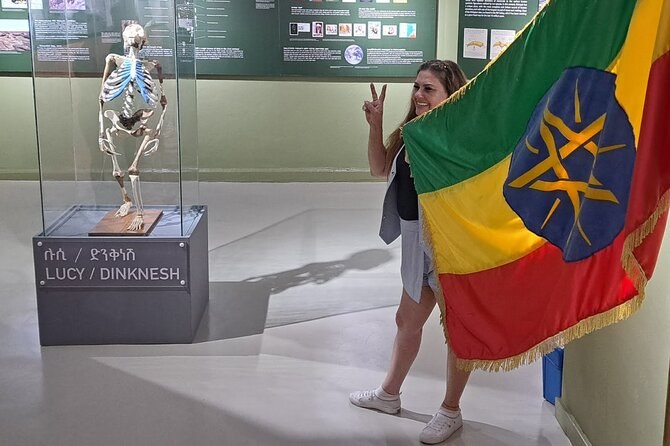
An hour at the National Museum of Ethiopia, on almost every route. Lucy is 3.2 million years old, about 40 per cent of a skeleton, found at Hadar in the Afar Triangle on 24 November 1974. Ethiopians call her Dinkʼinesh, meaning you are marvellous.
The thing nobody tells you is that the bones in the case are a cast. The originals are in the museum's archive. Above the basement there are three more floors — ancient and medieval objects with imperial regalia, then art, then ethnography — and an hour covers Lucy plus one of them. It closes on Mondays.
Mount Entoto, and the eucalyptus
One hour on most routes, two on two of them. Menelik II built his palace on this ridge before the city below existed, and the eucalyptus you drive up through was imported from Australia in his reign and planted mostly under Haile Selassie. The summit stands at 3,200 metres.
Two hours here is a walk; one hour is a viewpoint and a photograph. Both are worth having, and which you get is the clearest single difference between one departure and the next.
Mercato, and the guide who makes it legible
Forty minutes to two hours. It is the largest open-air market in Africa, spread over several square miles, with an estimated 13,000 people working across 7,100 businesses. Coffee is the main trade moving through it.
It is a working marketplace rather than a visitor attraction, and every operator who takes you in sends a guide with you. Travellers describe it as the stop a guide transforms — and the hour they remember afterwards. It closes on Sundays.
The two cathedrals
Holy Trinity gets an hour where it appears; St George's gets thirty minutes to an hour. Holy Trinity was begun in December 1931, halted by the Italian invasion and completed in 1942 to commemorate the victory over the occupation. St George's is octagonal, built by the Italian engineer Sebastiano Castagna in 1911, and burnt by the Fascist authorities in 1937.
Empress Zewditu was crowned at St George's in 1917 and Haile Selassie in 1930, which is why it became a place of pilgrimage for Rastafarians. One departure includes both in the fare; another charges about thirteen dollars between them.
The Ethnological Museum, in a palace
An hour at the Ethnological Museum, which is the museum of the Institute of Ethiopian Studies, founded in 1963, and it occupies the Gennete Le'ul palace, built in 1934 as Haile Selassie's principal residence. During the occupation Rodolfo Graziani lived and governed from it.
The first director of the institute was Richard Pankhurst, son of the suffragette Sylvia Pankhurst. Several routes use it as the Monday substitute when the National Museum is shut, which is a sensible swap rather than a downgrade.
The coffee ceremony, and Tomoca
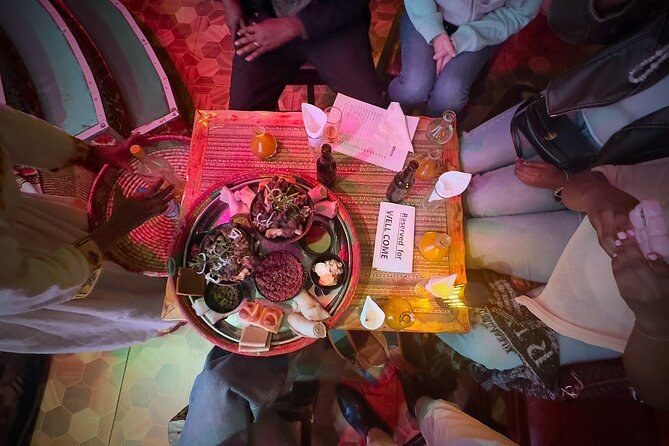
An hour for the ceremony where it appears, thirty minutes to an hour at Tomoca. Green beans are roasted in a pan in front of you, ground by hand and brewed in a clay jebena, then poured from a height into small cups. The grounds are brewed three times — abol, tona and baraka, the last meaning to be blessed.
Tomoca has been roasting since February 1953 and has 22 branches across the city. It is the sensible place to buy beans to take home.
The pass-bys, and why they still count
Meskel Square, the Lion of Judah, the Yekatit 12 obelisk, the Tiglachin Memorial and Shiro Meda market appear on itineraries as pass-bys rather than stops. That framing is honest and it is not a criticism: on a day with a flight at the end of it, five minutes at a window is the right amount for a monument.
The Yekatit 12 obelisk is the one worth asking your guide about. It is 28 metres of white stone at Sidist Kilo Square, inaugurated by Haile Selassie on 2 November 1944, and it marks the massacre that followed the attempt on Graziani's life in February 1937.
What each stop is given, side by side
| Stop | Time given | Closed | Appears on |
|---|---|---|---|
| National Museum of Ethiopia | 1 hour | Mondays | Almost every route |
| Mount Entoto | 1–2 hours | — | Almost every route |
| Mercato | 40 min – 2 hours | Sundays | Most routes |
| Ethnological Museum | 1 hour | — | The full-day routes |
| Holy Trinity Cathedral | 1 hour | — | Three routes |
| St George's Cathedral | 30 min – 1 hour | — | Four routes |
| Coffee ceremony | 1 hour | — | Most routes |
| Tomoca | 30 min – 1 hour | — | Two routes |
| Bata Mariam Church | 2 hours | — | One route |
One route gives a single church two hours. That is longer than any other stop on any departure here. If you would rather see one thing properly than five things briefly, that is the shape to look for.
The same place, a stop on one route and a window on another
Several places move between the two columns depending on the departure. Meskel Square is ten minutes on one itinerary and a pass-by on three others. St George's Cathedral is a full hour on two routes and thirty minutes on a third. Mercato swings from forty minutes to two hours.
That is worth checking rather than assuming, because a place you particularly want may be a window on the route you were about to book. The stop times sit on every card, and the difference between forty minutes and two hours in a market of 13,000 traders is not a detail.
Building your own order
Geography decides more than opening hours. The museums sit in the centre-north, the market is west, and the ridge is north and 800 metres up. A route that crosses the city three times spends an hour in traffic that a loop does not; the layout is drawn out on the map page.
On a private departure you can ask for the order to be changed on the morning. On a shared one you cannot, and that is the honest trade between the two.
Pick on the stop list, not the fare. Every departure names what it visits and for how long, side by side, on Addis Ababa Layover Tours. The stops themselves are explained at length on things to do on a layover.
Tours that visit these stops
Turn Your Layover Into an Unforgettable Ethiopian Experience
PrivateFree cancellation
From $96 per person